
Best Car Service for Corporate Transportation in Inland Empire
Corporate car service Inland Empire bookings are not all the same. Some are built for simple point-to-point rides. Others are designed for executives, clients, airport transfers, site visits, meetings, and multi-stop schedules where timing, presentation, and consistency matter more than getting the lowest possible fare.
If you are trying to decide what the best car service is for corporate transportation in Inland Empire, the right answer usually depends on the trip itself. A business traveler flying in for one meeting may need something different from a team attending a conference, a law firm sending a client to a deposition, or an executive assistant arranging airport pickup for a visiting board member.
This guide is written to help you compare options in a practical way. Instead of pushing one type of service as the answer for every situation, it breaks down what actually matters: reliability, driver professionalism, vehicle standards, booking support, route planning, airport coordination, flexibility, and total value. That makes it easier to choose the right service level for the job instead of paying for extras you do not need or underbooking a trip that requires more structure.
Quick answer
The best car service for corporate transportation in Inland Empire is usually a prearranged private sedan or SUV service with professional chauffeurs, clear booking support, dependable scheduling, and vehicles appropriate for business use. That does not mean it is always the most expensive option. It means it is often the option that balances punctuality, image, comfort, and trip management better than a basic on-demand ride.
For low-stakes local rides, a regular app-based ride may be enough. For airport transfers, executive pickups, client transportation, multi-stop schedules, or trips where delays would create larger problems, a structured corporate car service is often the better fit. In those situations, what you are really paying for is less uncertainty.
What “best” really means in business transportation
When people ask for the best car service, they often mean the nicest vehicle. In real business travel, that is only part of the equation. The better question is which service performs best under business conditions.
That usually includes the following:
- On-time pickup and dependable communication
- Professional drivers who understand business etiquette
- Clean sedans or SUVs suitable for executives, clients, and colleagues
- Support for airport timing, schedule changes, and return coordination
- Clear pricing structure before the trip starts
- Consistent service rather than random trip-to-trip variation
- Enough flexibility for multiple stops, waiting, or route adjustments
For a company, “best” often means lowest friction. The ride should not become another task the traveler has to manage. A solid corporate transportation setup reduces confusion, shortens handoff time, and protects the schedule. That is especially important when the passenger is a client, executive, attorney, physician, consultant, sales representative, or any employee whose time has a direct business cost.
This is why corporate travel decisions are usually about risk management more than luxury. The right service is the one least likely to create avoidable problems.
Main types of corporate transportation options
There are several ways to handle business transportation in the region. Each has a place. The mistake is assuming they all deliver the same experience.
1. App-based rideshare
Rideshare is convenient for simple trips and quick booking. It can work well when timing is flexible, the passenger is familiar with the area, and the company does not need a polished arrival experience. The downside is inconsistency. Vehicle type, driver presentation, airport pickup flow, and availability can vary.
2. Taxi service
Taxis can still be useful in certain locations, especially when immediate transportation is needed. For corporate use, though, they are often chosen less frequently than prearranged services because they usually provide less trip customization and a less curated business experience.
3. Shuttle or shared transportation
Shared transportation may reduce cost per passenger, but it can add wait time, extra stops, and less control over the schedule. For conferences, employee group moves, or budget-sensitive internal travel, that can be acceptable. For executive or client-facing trips, it often is not ideal.
4. Rental car
A rental makes sense when the traveler needs independence for a full day or multi-day itinerary. But it also adds navigation, parking, fueling, pickup lines, and personal driving fatigue. In some cases, the cheaper-looking choice becomes less attractive once time and hassle are factored in.
5. Prearranged private sedan or SUV service
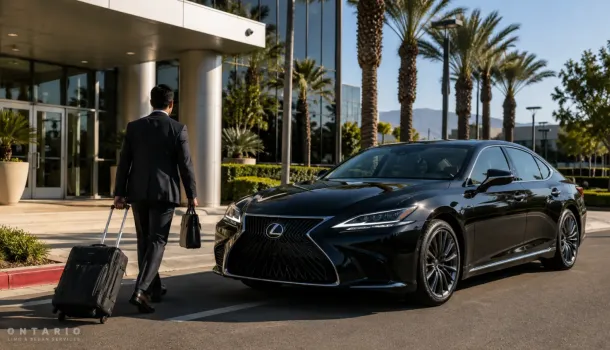
This is often the strongest fit for corporate transportation. A prearranged private car service is usually built around scheduled pickup, cleaner presentation, better communication, and a more predictable experience. This is commonly the category business travelers mean when they ask for corporate car service.
If you are comparing service styles locally, these related pages on executive transportation, corporate transportation, and chauffeur service in Ontario are useful supporting references.
Why corporate car service Inland Empire demand is different
The Inland Empire creates a slightly different transportation decision than some other Southern California markets. Trips are often longer, meeting points can be more spread out, and business travel may involve multiple cities in one day. A traveler could be flying into Ontario, meeting in Rancho Cucamonga, heading to Riverside, stopping in San Bernardino County, then returning for an evening departure or hotel drop-off.
That kind of geography rewards planning. When a region covers multiple business zones, industrial corridors, logistics hubs, office districts, and airport routes, the best service is usually the one that can manage movement smoothly rather than simply respond to a ride request in the moment.
For that reason, the best corporate car service in Inland Empire is usually one that understands all of the following:
- Airport pickup coordination
- Travel between Riverside and San Bernardino County business areas
- Early morning departures and after-hours arrivals
- Meeting schedules that do not always run on time
- How to handle multi-stop business travel without confusion
- The difference between employee transport and client-facing transport
That does not automatically eliminate other options. It simply means regional business travel benefits more from planning than many short urban rides do.
What to check before booking
If you want to choose carefully, these are the most useful things to confirm before you reserve anything.
Vehicle type
Ask whether the trip will be handled by a sedan, full-size SUV, sprinter, or another vehicle category. The best answer depends on passenger count, luggage, weather, and how formal the trip is. For one executive heading to a meeting, a sedan may be enough. For a client with luggage or a small team, an SUV may be the better choice.
Prearranged scheduling
A strong corporate provider should be comfortable confirming the trip ahead of time with clear pickup instructions, contact details, timing, and route notes. The more important the trip, the more useful that structure becomes.
Driver professionalism
For business travel, professionalism is not just about wearing a suit. It includes punctuality, communication, discretion, calm problem-solving, and knowing how to handle a traveler who may be working on the phone or preparing for a meeting.
Airport process
If the trip involves Ontario International Airport or another airport transfer, ask how delays, early arrivals, and meeting points are handled. Airport transportation needs more coordination than a basic curbside pickup.
Billing clarity
Corporate transportation can be billed point-to-point or hourly. Neither is inherently better. The right model depends on whether the itinerary is fixed, whether waiting is involved, and whether there may be additional stops.
Support when plans change
Business schedules change. Flights move. Meetings run long. Guests appear late. Ask how changes are handled. A service that is easy to work with during changes is usually worth more than one with a lower headline price but poor flexibility.
Travelers weighing airport-specific planning may also want to review reliable airport limo service, booking an airport limo service, and 24/7 transportation at Ontario Airport.
Airport and regional travel considerations
Corporate transportation in this market often centers on airport access. That is one reason service quality matters. Airport trips create the kinds of problems that expose weak transportation arrangements quickly. Pickup timing, terminal confusion, baggage delays, traffic, and return coordination all matter more than they do on a casual local ride.
For many business travelers, the decision is not “Should I pay more for a nicer car?” The decision is “Which option is least likely to disrupt my day?”
A structured car service is often strongest in these situations:
- Early departures where being late could mean missing a flight
- Late arrivals where the traveler wants a clear pickup plan
- Executive guests who should not be left figuring out curb logistics
- Travelers carrying presentation materials, samples, or multiple bags
- Trips that continue directly from the airport to a meeting or office
Not every airport ride requires that level of service. If the traveler is experienced, lightly packed, and flexible, a simpler ride option may work. But if the arrival is important enough that you would rather remove variables, prearranged service often becomes the better business decision.
That is also where the comparison with rideshare becomes more nuanced. A guide like Uber vs. limo service to the airport can help frame the tradeoff. One option may look cheaper at the booking screen, but the actual value depends on how much uncertainty the company is willing to tolerate.
Pricing expectations and disclaimers
There is no universal corporate transportation price because rates change based on time, mileage, demand, airport fees, wait time, stop count, vehicle size, and booking structure. Any number you see online should be treated as directional, not guaranteed, until the service details are confirmed.
That said, the cheapest option is not always the lowest-cost decision. A ride that looks less expensive can become more costly when it causes delay, confusion, missed time, or a poor client experience. In business transportation, cost should be measured against risk, not just fare.
Generally, private sedan or SUV service tends to cost more than casual on-demand transportation because it includes more than the drive itself. The rate may reflect advance scheduling, driver reservation, commercial operating overhead, airport handling, dispatch support, and service consistency.
Hourly service can make sense when:
- The itinerary may change
- There are multiple meetings or stops
- The passenger needs the vehicle to remain available
- Waiting time is expected
Point-to-point pricing often makes sense when:
- The route is simple and fixed
- The pickup and drop-off are clearly defined
- No waiting or return hold is needed
- The company wants straightforward trip billing
A smart booking question is not “What is your cheapest rate?” It is “What is included, and what could change the total?” That question usually leads to better decisions.
Pros and cons of each option
| Option | Pros | Cons |
|---|---|---|
| Rideshare | Fast booking, widely available, may cost less for simple trips | Inconsistent vehicle quality, less structure, weaker client-facing presentation |
| Taxi | Immediate transportation in some areas | Less tailored for business travel, fewer service layers |
| Shared shuttle | Lower per-passenger cost, practical for some groups | Extra stops, less schedule control, not ideal for executives |
| Rental car | Full independence for traveler | Parking, navigation, pickup lines, self-driving fatigue |
| Private sedan or SUV service | Professional, reliable, more polished, better for schedules and guests | Usually higher price than the most basic ride options |
Which service fits which business scenario
Here is the simplest way to match the transportation type to the actual need.
Use rideshare when:
- The trip is low stakes
- The traveler is comfortable handling details alone
- No client impression is involved
- A little inconsistency would not matter much
Use rental when:
- The traveler needs all-day independence
- There are many unscheduled stops
- Parking and navigation will not be a major burden
Use private corporate car service when:
- The rider is an executive, client, guest, or senior employee
- The schedule matters
- The company wants a cleaner and more predictable experience
- Airport pickup needs to be coordinated properly
- The trip includes multiple stops or a return segment
- The company values professionalism and reduced friction
That is why, for many businesses, the best car service for corporate transportation in Inland Empire is not the flashiest choice. It is the one that delivers consistency with the least amount of operational drama.
Ontario Limo and Sedan Services is one local example of a provider built around those use cases, with public profiles on Google Maps, Yelp, Facebook, and Instagram for travelers who want to compare business information and customer-facing presence before booking.
Takeaway
The best car service for corporate transportation in Inland Empire is usually the one that protects time, reduces uncertainty, and fits the purpose of the trip. For many business situations, that points to a prearranged private sedan or SUV service rather than a purely on-demand ride.
That does not mean every business traveler needs premium transportation. Some trips are simple and can be handled with simpler options. But when timing, professionalism, airport coordination, client impression, or executive comfort matters, a structured corporate car service usually provides better value than the cheapest ride on the screen.
If you evaluate vehicle fit, booking process, professionalism, airport handling, pricing clarity, and flexibility, the right choice usually becomes clear. That is the smartest way to choose transportation in a region where business travel often crosses cities, airports, and tight schedules in the same day.
Frequently Asked Questions
What is the best vehicle type for corporate transportation?
It depends on the passenger count and purpose. A sedan is often enough for one traveler with light luggage. An SUV may be a better fit for airport runs, executive travel, or client pickups where comfort and extra space matter. The best vehicle is the one that matches the schedule and business context without being unnecessarily large or costly.
Is rideshare good enough for corporate travel?
Sometimes, yes. For simple local trips with flexible timing, rideshare may be enough. For airport pickups, client-facing travel, executive transportation, and multi-stop business schedules, a prearranged corporate car service is often more dependable and easier to manage.
Should a company choose hourly or point-to-point pricing?
Point-to-point pricing usually works best for fixed routes with no waiting. Hourly service is often better when there are multiple stops, uncertain meeting lengths, or a need to keep the vehicle available throughout the trip. The right option depends on how predictable the itinerary is.
Why do companies use chauffeured sedan service instead of rental cars?
Because rental cars shift the work to the traveler. The traveler must pick up the car, navigate, park, refuel, and manage delays personally. A chauffeured sedan service can reduce stress and save productive time, especially when the traveler is preparing for meetings or moving directly between business commitments.
Is private car service only for executives?
No. It is common for executives, but it can also make sense for employees, visiting clients, legal or medical professionals, interview candidates, team members attending events, and guests unfamiliar with the region. The better question is whether the trip benefits from more structure and reliability.
What should I ask before booking corporate transportation in Inland Empire?
Ask what vehicle is included, whether the ride is prearranged, how delays are handled, whether pricing is hourly or point-to-point, what happens if plans change, and how airport pickups work. Those answers tell you more about service quality than branding language alone.